


Introduction
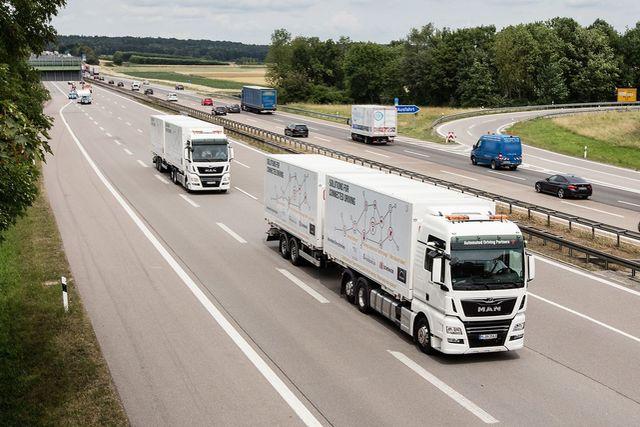
The Truck Platooning Market is rapidly emerging as a transformative solution for improving logistics efficiency, fuel economy, and road safety. Truck platooning involves a group of trucks traveling in a convoy using connected vehicle technology, where the lead truck controls the speed and route while the following trucks automatically synchronize their acceleration and braking. This technology leverages advanced driver assistance systems (ADAS), vehicle-to-vehicle (V2V) communication, and automated driving systems to reduce fuel consumption, minimize driver fatigue, and optimize freight movement. As transportation networks evolve, truck platooning is becoming a key enabler of smart and sustainable logistics systems worldwide.
Market Drivers
A major factor driving the truck platooning market is the growing demand for fuel efficiency and emission reduction in freight transportation. Platooning allows vehicles to maintain closer distances safely, reducing aerodynamic drag and fuel consumption by up to 10%. Increasing integration of V2V connectivity, sensors, and automation technologies is accelerating adoption. Additionally, governments and logistics operators are investing in intelligent transportation systems (ITS) to enhance road safety and efficiency. The rising shortage of skilled truck drivers and the push toward semi-autonomous freight systems also support market growth.
Market Challenges
Despite its benefits, truck platooning faces several challenges such as infrastructure readiness, cybersecurity risks, and regulatory inconsistencies across regions. Effective communication between trucks requires high-speed, reliable connectivity, which is not yet uniform globally. Concerns related to system reliability in adverse weather, potential network failures, and legal liability in case of accidents pose further barriers. Moreover, the cost of equipping fleets with advanced sensors, GPS, and V2V communication modules can be high for small and medium logistics companies, slowing mass adoption.
Market Opportunities
Advancements in autonomous driving technology and 5G connectivity create vast opportunities for the truck platooning market. The expansion of smart highways, government-funded pilot programs, and the deployment of connected vehicle infrastructure are paving the way for commercial adoption. Integration with fleet management platforms and logistics optimization software offers new efficiency levels for long-haul operations. Collaborations between truck manufacturers, technology providers, and logistics operators are expected to drive standardization and reduce costs. The growing trend of electrification in heavy commercial vehicles further complements platooning technology, enhancing its environmental benefits.
Regional Insights
North America leads the truck platooning market, supported by early trials, strong technology infrastructure, and initiatives by companies like Peloton Technology and Volvo Trucks. The U.S. Department of Transportation’s focus on autonomous and connected vehicles has accelerated deployment across major highways. Europe follows closely, with the European Truck Platooning Challenge demonstrating cross-border platooning feasibility. Countries like Germany, the Netherlands, and the UK are actively testing systems on major freight corridors. The Asia-Pacific region, led by Japan, China, and South Korea, is also emerging as a fast-growing market due to smart mobility initiatives and expanding logistics networks.
Future Outlook
The future of the truck platooning market looks promising, driven by the convergence of automation, connectivity, and sustainability goals. As regulatory frameworks mature and infrastructure improves, commercial deployment of multi-brand platooning systems is expected to expand. The integration of artificial intelligence (AI) and real-time traffic data will enable more adaptive and safer platoon formations. By the next decade, truck platooning is expected to play a vital role in autonomous freight systems, reducing operational costs and improving delivery efficiency across regional and international routes.
Conclusion
The Truck Platooning Market represents a major leap toward the future of intelligent freight transportation. With benefits including improved fuel economy, reduced emissions, and enhanced road safety, platooning aligns with global sustainability and logistics efficiency goals. Although technological, regulatory, and cost challenges persist, ongoing innovations and collaborations across the automotive and logistics sectors are paving the way for scalable adoption. As connectivity and automation technologies continue to evolve, truck platooning is set to redefine the dynamics of modern freight movement.

 Arabic
 French
 Spanish
 Portuguese
 Deutsch
 Turkish
 Dutch
Dutch
 Italiano
 Russian
 Romaian
 Portuguese (Brazil)
 Tiếng Việt